The AIM accreditation rule: What enrollment teams need to know before July 2027
A prospective transfer student may receive an admission offer before they understand which credits will count toward their next degree. For enrollment teams, answering that question requires coordination among admissions, the registrar and academic departments.

The Accreditation, Innovation, and Modernization (AIM) rule updates federal accreditation and institutional requirements, with new expectations for student outcomes and transfer credit transparency. The U.S. Department of Education announced the final rule on October 29, 2026, ahead of its October 30 publication in the Federal Register.
With the July 1, 2027 effective date approaching, university leaders have an opportunity to review how their teams evaluate prior coursework, explain decisions and help students understand the path to completion. Here is what the rule changes and how to prepare.
What is the AIM accreditation rule?
The AIM accreditation rule revises how the federal government recognizes accrediting agencies and updates related requirements for institutions. The final regulations amend 34 CFR Parts 600, 602 and 668, covering institutional eligibility, accreditor recognition and student information disclosures.
Federal recognition matters because recognized institutional accreditors help determine which colleges can participate in Title IV federal student aid programs. Title IV includes federal grants and student loans. AIM changes aspects of that quality assurance framework; accreditation remains one component of institutional eligibility.
The Department’s announcement describes its goals as strengthening student outcomes, improving affordability, encouraging innovation and increasing competition among accreditors. The administration also connects the reform to reducing unnecessary credential requirements that increase the time or cost of entering a profession.
What changes beyond transfer credit?
AIM combines a stronger emphasis on student outcomes with greater accreditor choice and changes to accreditation oversight. Understanding that broader scope helps enrollment leaders coordinate with colleagues responsible for academic quality, institutional research and accreditation.
Student outcomes and educational value
The rule emphasizes evidence of student achievement and program value, including completion, licensure results where applicable and post-completion outcomes. For institutional leaders, the practical starting point is to bring institutional research and academic teams into the preparation process and identify the evidence their accreditor will expect.
Competition and accreditor choice
AIM lowers barriers for new agencies seeking federal recognition and gives institutions more flexibility to change or add accreditors. That flexibility creates a strategic consideration for institutional leadership. Admissions teams should continue to describe their institution’s current accreditation accurately and route questions about potential changes to the appropriate campus leaders.
Academic freedom and accreditor independence
The rule also addresses academic freedom, intellectual diversity and conflicts of interest. WSCUC’s official update identifies these areas among the provisions affecting accredited institutions and explains that the commission is reviewing its policies before issuing further guidance.
What does AIM change for undergraduate transfer credit?
AIM adds expectations for transparent undergraduate transfer policies, timely student disclosures, course-specific explanations and appeals. The key provisions appear in § 602.24(e) and § 668.43. They connect the academic evaluation process with information students need before committing to an institution.
Publish clear policies and transcript timelines
Institutions must publicly disclose transfer criteria and the timeline for submitting transcripts for timely review. For your team, that means checking whether the website, catalog and application communications point students to the same current policy.
A useful operational review asks three questions: Can students find the policy? Can they identify the documents they need? Do they know when to submit them to receive information before making a commitment?
Explain credit decisions before commitment
When a student submits a transcript within the institution’s stated timeline, the rule requires written information about credits awarded, credits declined and estimated replacement time and courses, when applicable. The deadline is the earliest of signing an enrollment agreement, completing registration or making a nonrefundable financial commitment.
For admissions teams, mapping those commitment points against the evaluation process can reveal where an earlier handoff or additional review capacity would help. A prospective student’s application timeline and a department’s evaluation queue need to work together.
Document denials and provide an appeal
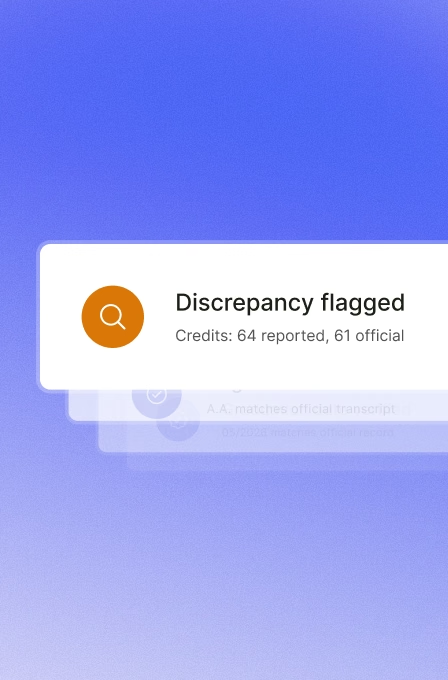
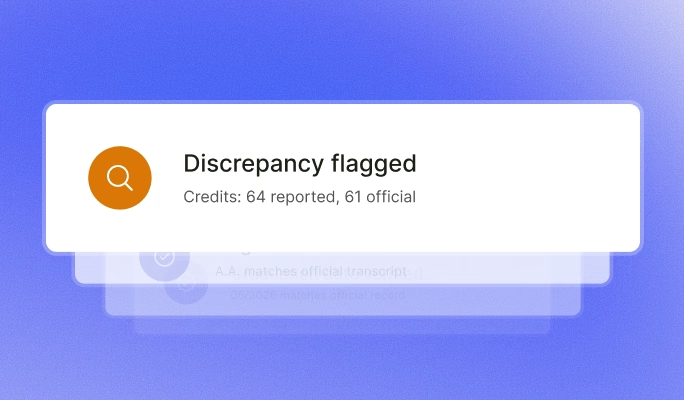
The rule calls for a written rationale specific to each course that does not receive transfer credit. It also requires an opportunity to appeal covered denials within 15 calendar days of receiving the institution’s written notification. That window concerns the student’s opportunity to appeal, rather than a universal deadline for resolving an appeal.
Teams can prepare by agreeing on who writes the explanation, who reviews an appeal and where the record lives. Shared templates can support clear communication while leaving space for the academic reasoning behind an individual decision.
Preserve academic judgment
AIM does not guarantee acceptance of every credit. Institutions retain academic criteria for comparability and curricular applicability. The rule restricts denials based on the originating institution or its accrediting agency when that agency holds federal recognition, while allowing academically grounded denials with written reasons.
The undergraduate scope also matters. Teams should avoid treating these provisions as a blanket rule for graduate and professional credit evaluations.
Why are higher education organizations raising concerns?
Higher education organizations have raised concerns about federal direction of accreditation, institutional autonomy and the workload associated with new requirements. A balanced understanding separates the administration’s intended benefits from the questions institutions and accreditors must address during implementation.
In its October 29 statement on the final AIM regulations, the Council for Higher Education Accreditation (CHEA) supports appropriate accountability while warning that central concerns remain unresolved. CHEA identifies federal prescription of accreditor standards, potentially duplicative requirements, academic freedom and increased regulatory burdens and costs.
The American Association of University Professors (AAUP), in its September 22 response to the proposed changes, argues that the proposal threatens institutional autonomy and academic freedom by expanding federal influence over accreditation. Those comments address the proposal, rather than a separate response to the final rule.
University leaders can acknowledge both perspectives while preparing. Clearer student information and manageable staff workflows belong in the same conversation, particularly when several offices contribute to a single credit decision.
What should enrollment and admissions teams do before July 2027?
Start with a coordinated review of policies, student communications and evaluation workflows, then test changes before the effective date. The following steps provide a practical preparation framework; they do not establish additional federal deadlines.
1. Bring the right campus partners together
Include admissions, enrollment management, the registrar, academic evaluators, institutional research, financial aid and the accreditation liaison. Ask counsel or compliance colleagues to help interpret obligations for your institution.
Agree on an owner for each part of the student experience, including policy updates, transcript intake, course review, written decisions and appeals. Record where responsibility moves from one office to another so staff know where to route a pending file.
2. Review the student journey against commitment dates
Walk through the process as a prospective transfer student. Start with the transfer webpage and continue through transcript submission, evaluation, registration and any nonrefundable payment.
Identify when your team can give an initial estimate, when an official evaluation becomes available and how you communicate pending decisions. This review can complement work to reduce transfer credit evaluation turnaround time without setting expectations that exceed available review capacity.
3. Make decisions easier to document and explain
Review the information evaluators need to record: the originating course, the decision, the applicable academic criterion and any additional review. Consider how the team will generate a student-facing explanation from that record.
Test a mix of familiar equivalencies and courses that require faculty input. Include an appeal scenario so reviewers can check whether staff can retrieve the original rationale and route the request consistently.
4. Align recruitment messaging with evaluation capacity
Credit clarity can support your transfer student recruitment strategy by helping students understand the information available at each stage. Review campaign language, counselor scripts and event materials alongside the published transfer policy.
Explain what an unofficial estimate covers, what documentation an official review requires and who can answer a course-specific question. Give staff a shared way to communicate missing information or a pending academic review.
5. Track service measures and follow accreditor guidance
Choose a manageable set of internal measures, such as transcript-to-decision time, pending faculty reviews, incomplete files and appeal volume. Use those measures to identify where staff need capacity or clearer handoffs. These are suggested operational measures, rather than a new federal reporting checklist.
Continue monitoring your accreditor’s updates. In its November 6 implementation alert, the Middle States Commission on Higher Education advises institutions to follow existing commission requirements until revisions take effect. Federal changes do not automatically replace every accreditor policy on the announcement date.
{{eddydb-banner}}
How can EdVisorly support transfer preparation?
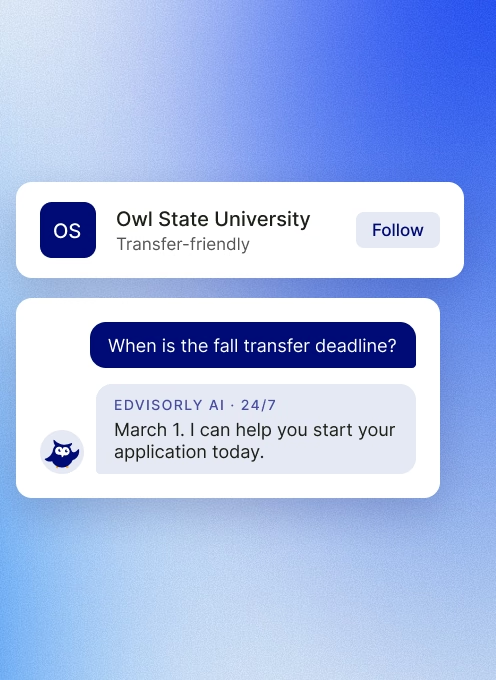
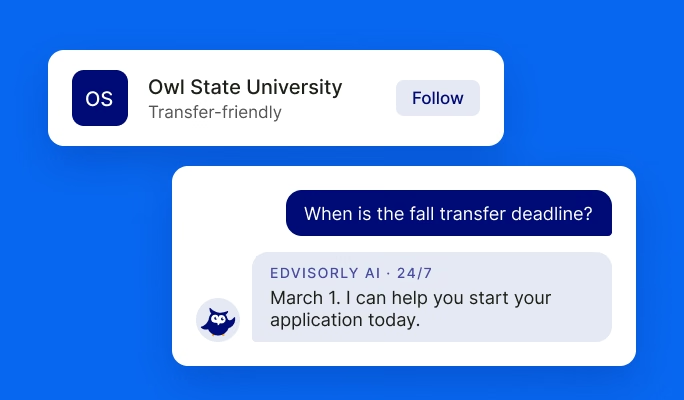
The EdVisorly AI Enrollment Platform can support the transcript processing, equivalency review and early credit clarity that underpin a coordinated transfer experience. Institutions retain responsibility for academic decisions, required disclosures and their compliance approach.
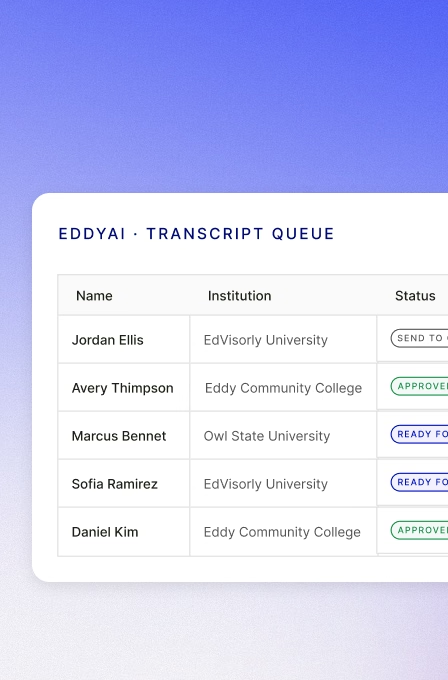
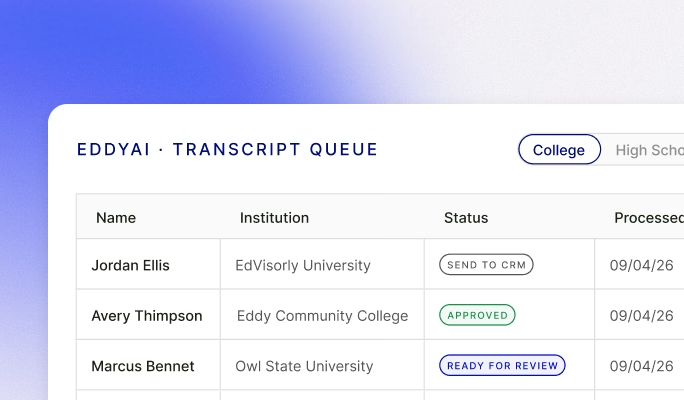
EddyAI™ supports transcript processing so staff can spend more time reviewing information and helping students. EddyDB™ supports staff review and management of course equivalencies, helping teams organize institutional equivalency information.
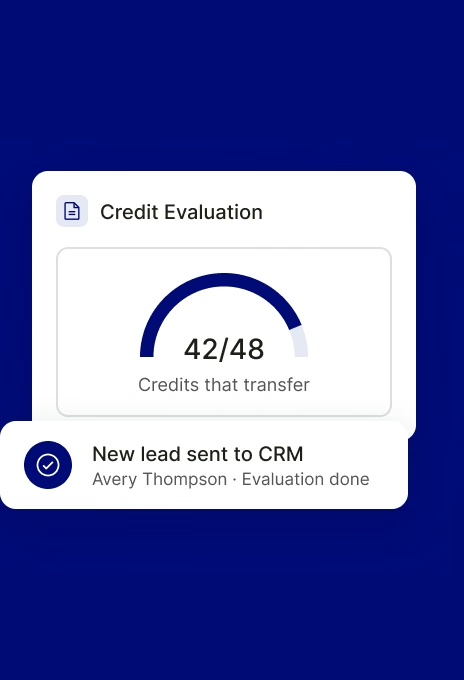
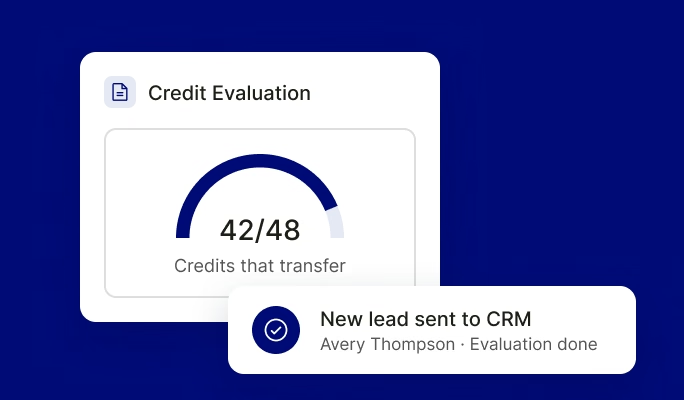
EddyNavigate™ can embed on a university’s website or Common App profile and give prospective students an instant unofficial credit equivalency report based on institutional equivalency information. Each evaluation becomes a high-intent lead sent to the university’s CRM, giving enrollment teams an opportunity to follow up while the student is interested.
An unofficial report supports early planning by helping prospective students understand how their credits may transfer. University staff retain responsibility for official credit decisions, applying the institution’s academic standards and transfer policies.
Connect with EdVisorly about your transfer workflow to discuss how your team can support clearer credit information and more coordinated enrollment operations before July 2027.
Frequently asked questions
The main distinctions concern implementation timing, academic discretion and the role of unofficial credit information. These answers summarize the points enrollment teams should keep consistent across campus communications.
When does the AIM rule take effect?
The rule takes effect July 1, 2027. It permits optional early implementation beginning January 1, 2027, but accreditors cannot use that option to impose resulting new requirements on institutions before July 1. Consult the implementation provisions and your accreditor’s guidance.
Does AIM require universities to accept every transfer credit?
No. Institutions retain academic criteria for evaluating coursework. The rule adds transparency, written reasoning and appeal expectations while restricting denials based on the originating institution or federally recognized accreditor.
Does AIM set one transcript submission deadline for all colleges?
No. Institutions publish their own timelines for timely review. Teams should ensure those timelines support the required disclosures before the student’s earliest specified commitment point.
Can an unofficial equivalency report replace an official credit decision?
An unofficial report helps students explore potential credit outcomes. Universities should maintain a separate process for official decisions and required disclosures, with appropriate academic review and clear communication about the status of each evaluation.
Similar Guides

What is Enrollment Management? Everything You Need to Know
Enrollment management has become a critical function for colleges and universities facing increasing competition, changing demographics, and financial pressures. But what is enrollment management exactly, and why is it so important for educational institutions today? This comprehensive guide explores the definition, history, components, and best practices of enrollment management to help educational leaders develop effective strategies for institutional success.

Transfer Shock: What It Is and How Universities Can Help Prevent It
Transfer shock is not an informal label your advising staff coined to describe a rough first semester. It is a named, empirically documented phenomenon with a 60-year research record behind it, and it deserves the same rigor your office would apply to any other retention risk factor.

What Is an Admission Management System: How to Choose the Right One
In today's competitive educational landscape, institutions face increasing pressure to streamline their operations while delivering exceptional experiences to prospective students. At the heart of this challenge lies the admission process—a critical function that can either set the stage for student success or create unnecessary barriers. This is where an admission management system becomes essential.