
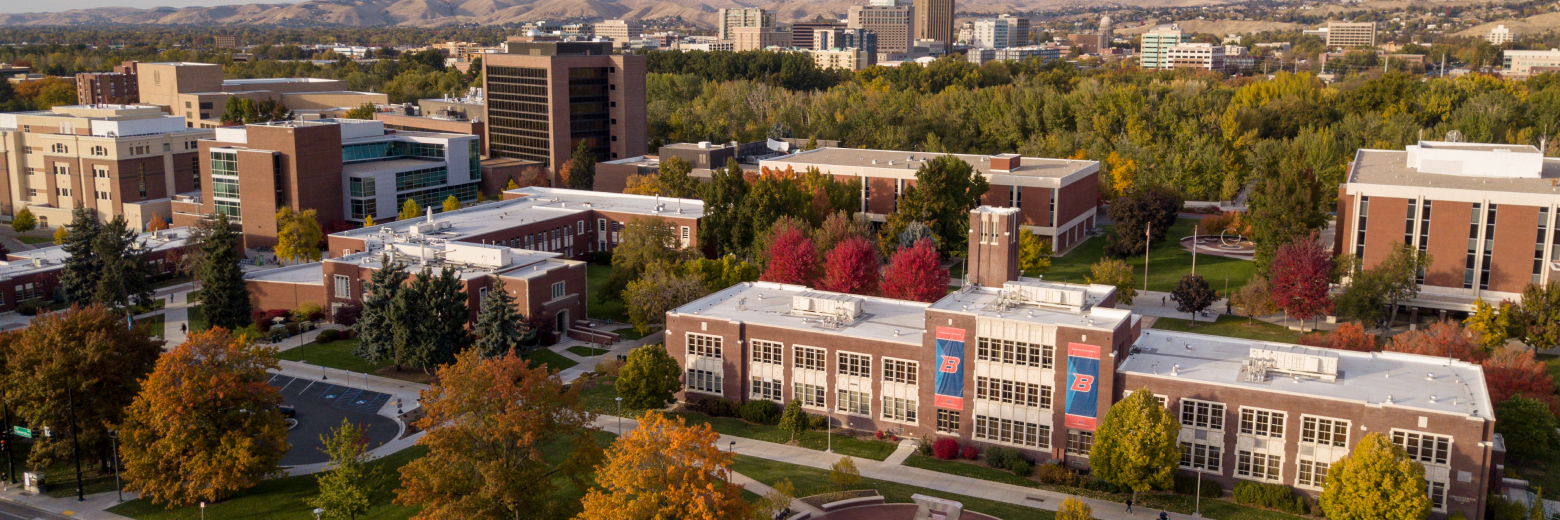


Boise State University Transfer Requirements





Boise State University Overview
Boise State University is a public doctoral research university in Boise, Idaho, classified as an R2: Doctoral Universities – High research activity institution by Carnegie and actively pursuing R1 status. Dedicated to advancing Idaho and the world, Boise State provides an innovative educational environment with diverse associate, bachelor's, master's, and doctoral programs. The university makes the smooth transition of new transfer students a top priority, offering resources like Transfer Pathways and required academic advising to help students integrate seamlessly. With over 1,900 new transfer students enrolling in a recent term, Boise State cultivates a supportive, high-research environment to help all students succeed.
Boise State University Student Body at a Glance
As of Fall 2025, Boise State University has a total enrollment of 28,519 students. The degree-seeking population includes 18,729 undergraduates and 2,826 postgraduates. The university is experiencing substantial growth, setting a record with its largest incoming class of 3,934 first-time undergraduate students in its history and achieving 10% total enrollment growth since 2021.
Boise State University Transfer Admission Stats
Boise State University enrolled approximately 1,344 new transfer students in Fall 2023. The university has a transfer acceptance rate of 81.9% for the 2024 application year, accepting 2,459 out of 3,000 applicants. The transfer-specific graduation rate is not publicly available.
Academic Benchmarks for Transfers
Transfer applicants must have a minimum cumulative transfer GPA of 2.25, provided they are in good academic standing with their previous institution. While Boise State University generally maintains a test-optional admissions policy for first-year students, the middle 50% of admitted freshmen scored between 960 and 1180 on the SAT and between 20 and 27 on the ACT, which can serve as a useful reference point.
Why transfer to Boise State University?
Boise State University offers exceptional value with full-time resident tuition and fees at $9,364 and non-resident tuition and fees at $28,478 for both semesters. The university is committed to your academic journey, accepting all college-level credit from regionally accredited institutions and offering resources like the Transfer Equivalency System (TES) and established Transfer Pathways, particularly for students transferring with an Associate of Applied Science degree.
You will join a vibrant community where your success is prioritized. Ninety percent of Boise State graduates report that their first job after graduation was directly related to their career goals, and alumni earn a strong average salary of $54,800 upon graduation, growing to $99,800 with 10 years of experience. New transfer students are required to meet with an academic advisor to review their transfer credits and plan their first semester, ensuring a smooth and clear path to completing your bachelor's degree.
Are you looking to transfer to Boise State University?
Boise State University Transfer Information
Boise State University is committed to making the transfer process smooth and welcoming, with a high transfer acceptance rate of 81.9%. You are considered a transfer student if you have completed at least one college-level credit after high school graduation, though admission standards differ for those with fewer than 14 post-high school credits. Your credits are valued, and you can use the Transfer Equivalency System to see how they might apply toward your degree. To finalize your transition, be sure to submit your application and official transcripts, complete the FAFSA (school code 001616), and register for new student orientation. Incoming transfer students are automatically considered for various merit and need-based scholarships, with important deadlines throughout the year.
Academic Benchmarks for Transfer Requirements
Transfer applicants to Boise State University must submit several materials as part of their application. Here are the key requirements and details for admission:
Required or Conditional:
- College Transcript: Official transcripts from EACH accredited college/university attended must be submitted.
- High-School Transcript: Required if you have completed less than 14 transferable academic semester (21 quarter) GPA credits after high school.
- Minimum GPA: A cumulative transfer GPA of 2.25 is required for standard admission.
- Intent to Enroll: Required after admission to reserve your spot and register for orientation and classes.
Optional or Not Required:
- Personal Statement: Highly encouraged for applicants with a cumulative transfer GPA of 2.00–2.24 and no associate degree, as part of an additional review process.
- Letters of Recommendation: N/A (Not explicitly required for general transfer admission).
- Interview: N/A.
Credit Guidelines:
- Minimum College Credits: You must have completed at least one transferable academic GPA credit after high school to be classified as a transfer student.
- Residency Credits: You must complete 30 upper-division credits at Boise State for a baccalaureate degree.
Transfer Application Deadlines
Boise State University accepts transfer students for both Fall and Spring semesters and operates on a rolling admissions basis. The Fall transfer application and scholarship priority deadline is February 15, with the standard application deadline being May 1. For Spring admission, the application and scholarship priority deadline is October 1, and the standard application deadline is December 1. Priority deadlines are recommended for the best consideration, as applications received after these dates will still be evaluated and reviewed on a space-available basis.
Transfer Decision Dates
Boise State University (BSU) processes transfer admission decisions on a rolling basis. Fall applications open on August 1st, with an application and scholarship priority deadline of February 15th, and a standard application deadline of May 1st. BSU begins sending out admission decisions as early as mid-September and continues to do so on an ongoing basis. Applying by the priority deadline provides the strongest consideration for scholarships and admission. For Spring admission, the priority deadline for application and scholarships is October 1st, and the final application or materials deadline is December 1st.
Frequently Asked Questions
What is the transfer acceptance rate at Boise State University?
Boise State University has a transfer acceptance rate of 81.9% as of the 2024 application year. This rate is based on 2,459 accepted applicants out of 3,000 total applicants. The average GPA for accepted transfer students stands at 3.5.
How does Boise State define a transfer student for admission?
You are classified as a transfer student if you have completed at least one transferable academic credit after graduating from high school or earning your GED. However, if you have earned less than 14 college credits after high school, you will be evaluated based on first-year admission standards.
What are the key application and enrollment deadlines for transfer students?
For the Fall Semester, the Intent to Enroll priority deadline is typically May 1, and for the Spring Semester, the Intent to Enroll priority deadline is December 1. There are separate, earlier deadlines for scholarships, such as October 1 for spring scholarships.
How can I find out if my credits will transfer to Boise State?
You can use the Boise State Transfer Equivalency System (TES) to get an idea of how your courses might transfer. Your official transcripts are evaluated by the Registrar's Office, and once evaluated, you can review your Academic Advisement Report on your myBoiseState account to see how the credits apply to your degree.
Is New Student Orientation required for transfer students?
Yes, new student orientation is a required and important step. It is typically where you meet with an academic advisor who will review your transfer credits and prepare a plan for class registration. Students who do not attend orientation will be unable to register for the upcoming semester until Open Enrollment begins.
Are there specific scholarships and financial aid options for transfer students?
Yes, transfer students can explore transfer-specific scholarships by visiting the Boise State Financial Aid and Scholarship webpage and should complete the FAFSA (Boise State School Code: 001616). Non-resident students from member states may also be eligible for the Western Undergraduate Exchange (WUE) tuition reciprocity program.
Are you looking to transfer to Stony Brooks?

.avif)
.png)
.avif)